| Chef Mayra 411 Issue #82 - News from the Chef Mayra Kitchen | ||||||||||||||||||

|
About The Dr of Flavor

- Vegan Carib Chef Mayra
- Cakes for all Occasions VEGAN MEALS TO GO ! call for a quote all services are personalized **Five - Three - Two days Meal Plans + Bonus meals free per week. Email us at Bakery@MyChefMayra.com Cooking Classes.. Be part of the Chef Cooking Show. http://www.chefmayra.com/show.html Let the Chef help you plan some healthy meals. Sports Nutrition, In home catering, PRIVATE AND PUBLIC cooking lessons, Caribbean & Southwest cuisine and sport Nutrition. The Chef have helped her clients: Improve eating habits Lose weight Break the sugar addiction Find balance Increase energy and vitality Improve chronic ailments Heal chronic skin problems Learn easy and fun cooking/shopping techniques to better improve your eating habits CONTACT ME TODAY FOR A FREE HEALTH HISTORY CONSULTATION ! Vegan Food Is SEXY ! Healthy Food has Flavor Let me cook for you
Slideshow


Showing posts with label health. Show all posts
Showing posts with label health. Show all posts
Tuesday, February 15, 2011
Get Your Sexy On Food Demo February 26 ~ And more of the 411 Issue # 84
http://www.aweber.com/b/hG66
 Join Chef Mayra for special recipes and special guests on the next Lean, Green & Sexy Cooking Show, Tomorrow at Noon PST.
 February 26
 May 19-22
 February Pet Care Specials


Friday, June 19, 2009
Chocolate, Cheese, Meat, and Sugar -- Physically Addictive Foods -
Very Interesting...... So if you think you can not break from Meat and Cheese.. How about Sugar?
----------------
Now playing on iTunes: Happy Holidays Demo
via FoxyTunes
----------------
Now playing on iTunes: Happy Holidays Demo
via FoxyTunes
----------------
Now playing on iTunes: Happy Holidays Demo
via FoxyTunes
| Click to view this email in a browser
| ||||
| |


----------------
Now playing on iTunes: Happy Holidays Demo
via FoxyTunes
----------------
Now playing on iTunes: Happy Holidays Demo
via FoxyTunes
----------------
Now playing on iTunes: Happy Holidays Demo
via FoxyTunes
Monday, June 8, 2009
Why DO I need to buy Local or Support the Local Vendors?
Why buy local?
There are countless reasons why buying local food is both rewarding and delicious, including enjoying the taste of fresh food, improved health and nutrition, environmental stewardship, support for family farms and rural communities, and ensuring animal welfare.
There is also significant peace of mind in knowing where our food comes from. One of the biggest benefits to buying food locally is having someone to answer questions about how it was grown and raised. What goes into that loaf of bread? Can we be certain that the hog that is now bacon lived a life without suffering? How do we know those jalapeños are salmonella free?
Developing a relationship with local farmers gives us an "in" with our local food system. At farmers' markets we can get answers to questions like: When do tomatoes come into season? How might I use celeriac? Often, we can take a tour of the farm our food comes from. Some farmers are thrilled to share their knowledge and experience with their customers. Ask about the challenges your local farmers face and what they are doing to address them. It doesn't have to be complicated. Ask about the weather! Any farmer will be pleased to talk about how the growing season is going and how that affects the food they grow. Knowing local farmers can go a long way to simplifying buying local.
Another significant reason to buy local is to keep food miles to a minimum. "Food miles" refer to the distance a food item travels from the farm to your home. The food miles for items in the grocery store are, on average, 27 times higher than the food miles for goods bought from local sources.1
In the U.S., the average grocery store's produce travels nearly 1,500 miles between the farm where it was grown and your refrigerator. About 40% of our fruit is produced overseas and, even though broccoli is grown all over the country, the broccoli we buy at the supermarket travels an average of 1,800 miles to get there. Notably, nine percent of our red meat comes from foreign countries, some as far away as Australia and New Zealand.
Our food is trucked across the country, hauled in freighter ships over oceans, and flown around the world. A tremendous amount of fossil fuel is burned to transport foods such long distances, releasing carbon dioxide, sulfur dioxide, particulate matter and other pollutants that contribute to global climate change, acid rain, smog and air and sea pollution. The refrigeration required to keep our fruits, vegetables, dairy products and meats from spoiling during their long journeys burn up even more fossil fuel. In contrast, local and regional food systems produce 17 times less CO2.4
Economics of local
The significant difficulties of earning a living wage as a farmer are often masked by headlines about subsidies and record high crop prices. In reality, farmers are earning less producing crops these days than they did in 1969, despite the fact that American farmers have almost doubled productivity over the past four decades. Farmers aren't just earning less, current prices do not even cover the cost of production. Until just recently the difference between farm income nationwide and what it cost to grow and raise American crops could be counted in the billions. To make ends meet, and often to get health insurance, more than half of American farmers work a second off-farm job
Buying locally or directly from farmers can dramatically increase a farmer's income. The Maine Organic Farmers and Gardener's Association published a study that demonstrates what would happen if consumers shifted 1% of their purchasing power to buy locally grown products: farmers would see a gain of 5% in their income. Even better, buying direct from a farmer sends 90% of those food dollars back to the farm. Increasing farm income means more money can be spent locally by the farmer to run their business and home, helping keep the local economy alive.
Annually, Americans consume more than $600 billion9 in food. In most communities today food is purchased entirely at a grocery store or market, with only about 7% of local food dollars staying in the community.10 The other 93% of the modern food dollar travels to pay processors, packagers, distributors, wholesalers, truckers and the rest of the infrastructure that a global food system demands, a stark comparison to 40% in 1910 by contrast, 40% of food dollars spend remained in the local economy.11 When more food dollars stay in the community, through buying local, they are transformed into thriving main streets and local jobs.
If you can't buy local...
While some people may enjoy the challenge of an all-local diet, it doesn't work for everyone. If products are not available locally or regionally, look for items produced in the United States. Remember—local means as close to home as possible, in some cases that may mean oranges from California or Florida, rather than Chile or Israel.
When shopping for more exotic ingredients like chocolate, coffee or bananas, look for products labeled "Fair Trade" or "Rain forest Alliance Certified." The fair trade label means that farmers and farm workers in developing nations receive a fair price for their product, work directly with buyers, and prioritize sustainable farming methods without forced child labor and the use of a dozen of the most harmful pesticides. To be fair trade certified, products must be grown by small-scale producers who are able organize themselves in either cooperatives or unions. Fair trade products and companies are certified by independent third parties like Trans Fair USA or Fair Trade Labeling Organization International. Companies selling fair trade products have also shown commitment to helping the farmers they work with develop long-term sustainable communities and businesses.
Rain forest Alliance labeling follows standards set by the Sustainable Agriculture Network (SAN, formally known as the Conservation Agriculture Network) that are designed to promote tropical conservation. Products with this label are grown with environmentally responsible management practices including integrated pest and disease management, soil and water conservation. This standard also includes requirements for fair labor practices and good community relations. The Rain forest Alliance Certified label standards have been tailored to crops in specific regions. The standards specify that waterways must be protected with buffer zones and monitored for contamination. Workers must be paid minimum wage and have the right to organize.
Both of these labels are third-party certified, which means that independent inspectors ensure farmers' compliance. Since products like coffee and chocolate are difficult to grow in the United States, labels like these can be a good alternative to buying locally.
What you can do
Join the growing movement of consumers around the world who are making a little extra effort to find food raised nearby. You might be surprised to learn how many farms there are in your area. If you're not sure how to find them, just enter your zip code into the Eat Well Guide. You can also find out what foods are seasonal in your area by checking out our state-by-state listing of seasonal food.
Start small and don't expect to change all your eating habits overnight. Commit to purchasing one thing locally each week or each month. Once you see how easy it is and you enjoy the great taste, you'll surely go back for more!
Community supported agriculture (CSA) programs
CSA provides a direct link between local farmers and consumers. Each season, members purchase a share of a farmer's crop before it's planted. This allows the farmer to pay for seed, water and equipment upfront, so s/he is less reliant on banks and loans. Each week during the harvest time, usually June through October, the farmer delivers great tasting, healthy food to the members at pre-determined locations. In some instances, members pick up their share directly from the farm.
By purchasing a share in a farmer's crop, you share in the bounty. In good years, you will get more; in not-so-good years, you won't get as much. It's a great way to try vegetables you might not normally eat—or might never have heard of! Most CSA programs provide vegetables and fruit, though many also offer other products.
To find a CSA program in your area, visit the Alternative Farming Systems Information Center. If you can't find a CSA program in your area, start one! Just Food, a nonprofit organization based in New York City, helps start CSA programs in all five boroughs.
Farmers' markets
A great way to buy local is to shop at farmers' markets, where you can ask the farmer how the food was raised and produced.
Buy Local Challenge
The Buy Local Challenge is simply a pact you make with friends, family members or co-workers to eat locally. You can be as lenient or as strict as you like - from agreeing to cook one meal with local ingredients to eating only local food for one month (now that's a challenge!)
The key is to engage others in a conversation about eating locally, and what better way is there than to try it yourself? Share your experiences, swap recipes, and discover new foods! Then visit Sustainable Table's forum, The Parlour, to talk about your experiences.
If you would like to use this as an opportunity to educate others about local, sustainable food, show them The Meatrix films, or visit the Sustainable Table web site for information you can print out and share.
Vanguard Communications, a public relations firm in Washington DC, developed their own Buy Local Challenge. Visit their Buy Local Challenge for ideas on what you can do.
Adopt a local farmer
You can use the Eat Well Guide to find a farmer or farmers' market in your area. If you find a farmer you like, "adopt" him or her.
* Encourage your friends and neighbors to buy the farm's products.
* Invite the farmer over for a sustainable dinner party and ask them talk
to your family and friends about what they do.
* Get your local supermarket to start carrying their products.
* Help get the word out about what good farmers they are!
Grow Your Own
Whether it's a plot in your backyard or a small window herb garden, growing your own food is a richly rewarding experience. Many towns have gardening classes, but it's easy to simply buy some seeds and experiment. The National Gardening Association has tips on getting started.( Ask me if you live in Las Vegas, Nevada)
If you live in an urban area and don't have land to plant on, you can often find community gardens that offer plots in exchange for some volunteer time. Visit the American Community Gardening Association for more information. And once you grow all that great food, learn how to can, freeze or preserve it.
The Next film is dedicated to our Planet ! Please watch 1:33 Min long
About the film !
***We are living in exceptional times. Scientists tell us that we have 10 years to change the way we live, avert the depletion of natural resources and the catastrophic evolution of the Earth's climate.
The stakes are high for us and our children. Everyone should take part in the effort, and HOME has been conceived to take a message of mobilization out to every human being.
For this purpose, HOME needs to be free. A patron, the PPR Group, made this possible. EuropaCorp, the distributor, also pledged not to make any profit because Home is a non-profit film.
HOME has been made for you : share it! And act for the planet.
Yann Arthus-Bertrand
PPR is proud to support HOME
http://www.ppr.com
HOME is a carbon offset movie
http://www.actioncarbone.org
More information about the Planet
http://www.goodplanet.info
Website: http://www.home-2009.com
Chef Mayra
702.722-0108 Office
http://MyChefMayra.com/
Connect Chef Mayra a.k.a Dr Flavor:
LinkedIn| Facebook| BlogSpot & TV/Radio Show | Ning | Twitter | BlogSpot
Why Organic, Why Animal Free & Why Green?
There are countless reasons why buying local food is both rewarding and delicious, including enjoying the taste of fresh food, improved health and nutrition, environmental stewardship, support for family farms and rural communities, and ensuring animal welfare.
There is also significant peace of mind in knowing where our food comes from. One of the biggest benefits to buying food locally is having someone to answer questions about how it was grown and raised. What goes into that loaf of bread? Can we be certain that the hog that is now bacon lived a life without suffering? How do we know those jalapeños are salmonella free?
Developing a relationship with local farmers gives us an "in" with our local food system. At farmers' markets we can get answers to questions like: When do tomatoes come into season? How might I use celeriac? Often, we can take a tour of the farm our food comes from. Some farmers are thrilled to share their knowledge and experience with their customers. Ask about the challenges your local farmers face and what they are doing to address them. It doesn't have to be complicated. Ask about the weather! Any farmer will be pleased to talk about how the growing season is going and how that affects the food they grow. Knowing local farmers can go a long way to simplifying buying local.
Another significant reason to buy local is to keep food miles to a minimum. "Food miles" refer to the distance a food item travels from the farm to your home. The food miles for items in the grocery store are, on average, 27 times higher than the food miles for goods bought from local sources.1
In the U.S., the average grocery store's produce travels nearly 1,500 miles between the farm where it was grown and your refrigerator. About 40% of our fruit is produced overseas and, even though broccoli is grown all over the country, the broccoli we buy at the supermarket travels an average of 1,800 miles to get there. Notably, nine percent of our red meat comes from foreign countries, some as far away as Australia and New Zealand.
Our food is trucked across the country, hauled in freighter ships over oceans, and flown around the world. A tremendous amount of fossil fuel is burned to transport foods such long distances, releasing carbon dioxide, sulfur dioxide, particulate matter and other pollutants that contribute to global climate change, acid rain, smog and air and sea pollution. The refrigeration required to keep our fruits, vegetables, dairy products and meats from spoiling during their long journeys burn up even more fossil fuel. In contrast, local and regional food systems produce 17 times less CO2.4
Economics of local
The significant difficulties of earning a living wage as a farmer are often masked by headlines about subsidies and record high crop prices. In reality, farmers are earning less producing crops these days than they did in 1969, despite the fact that American farmers have almost doubled productivity over the past four decades. Farmers aren't just earning less, current prices do not even cover the cost of production. Until just recently the difference between farm income nationwide and what it cost to grow and raise American crops could be counted in the billions. To make ends meet, and often to get health insurance, more than half of American farmers work a second off-farm job
Buying locally or directly from farmers can dramatically increase a farmer's income. The Maine Organic Farmers and Gardener's Association published a study that demonstrates what would happen if consumers shifted 1% of their purchasing power to buy locally grown products: farmers would see a gain of 5% in their income. Even better, buying direct from a farmer sends 90% of those food dollars back to the farm. Increasing farm income means more money can be spent locally by the farmer to run their business and home, helping keep the local economy alive.
Annually, Americans consume more than $600 billion9 in food. In most communities today food is purchased entirely at a grocery store or market, with only about 7% of local food dollars staying in the community.10 The other 93% of the modern food dollar travels to pay processors, packagers, distributors, wholesalers, truckers and the rest of the infrastructure that a global food system demands, a stark comparison to 40% in 1910 by contrast, 40% of food dollars spend remained in the local economy.11 When more food dollars stay in the community, through buying local, they are transformed into thriving main streets and local jobs.
If you can't buy local...
While some people may enjoy the challenge of an all-local diet, it doesn't work for everyone. If products are not available locally or regionally, look for items produced in the United States. Remember—local means as close to home as possible, in some cases that may mean oranges from California or Florida, rather than Chile or Israel.
When shopping for more exotic ingredients like chocolate, coffee or bananas, look for products labeled "Fair Trade" or "Rain forest Alliance Certified." The fair trade label means that farmers and farm workers in developing nations receive a fair price for their product, work directly with buyers, and prioritize sustainable farming methods without forced child labor and the use of a dozen of the most harmful pesticides. To be fair trade certified, products must be grown by small-scale producers who are able organize themselves in either cooperatives or unions. Fair trade products and companies are certified by independent third parties like Trans Fair USA or Fair Trade Labeling Organization International. Companies selling fair trade products have also shown commitment to helping the farmers they work with develop long-term sustainable communities and businesses.
Rain forest Alliance labeling follows standards set by the Sustainable Agriculture Network (SAN, formally known as the Conservation Agriculture Network) that are designed to promote tropical conservation. Products with this label are grown with environmentally responsible management practices including integrated pest and disease management, soil and water conservation. This standard also includes requirements for fair labor practices and good community relations. The Rain forest Alliance Certified label standards have been tailored to crops in specific regions. The standards specify that waterways must be protected with buffer zones and monitored for contamination. Workers must be paid minimum wage and have the right to organize.
Both of these labels are third-party certified, which means that independent inspectors ensure farmers' compliance. Since products like coffee and chocolate are difficult to grow in the United States, labels like these can be a good alternative to buying locally.
What you can do
Join the growing movement of consumers around the world who are making a little extra effort to find food raised nearby. You might be surprised to learn how many farms there are in your area. If you're not sure how to find them, just enter your zip code into the Eat Well Guide. You can also find out what foods are seasonal in your area by checking out our state-by-state listing of seasonal food.
Start small and don't expect to change all your eating habits overnight. Commit to purchasing one thing locally each week or each month. Once you see how easy it is and you enjoy the great taste, you'll surely go back for more!
Community supported agriculture (CSA) programs
CSA provides a direct link between local farmers and consumers. Each season, members purchase a share of a farmer's crop before it's planted. This allows the farmer to pay for seed, water and equipment upfront, so s/he is less reliant on banks and loans. Each week during the harvest time, usually June through October, the farmer delivers great tasting, healthy food to the members at pre-determined locations. In some instances, members pick up their share directly from the farm.
By purchasing a share in a farmer's crop, you share in the bounty. In good years, you will get more; in not-so-good years, you won't get as much. It's a great way to try vegetables you might not normally eat—or might never have heard of! Most CSA programs provide vegetables and fruit, though many also offer other products.
To find a CSA program in your area, visit the Alternative Farming Systems Information Center. If you can't find a CSA program in your area, start one! Just Food, a nonprofit organization based in New York City, helps start CSA programs in all five boroughs.
Farmers' markets
A great way to buy local is to shop at farmers' markets, where you can ask the farmer how the food was raised and produced.
Buy Local Challenge
The Buy Local Challenge is simply a pact you make with friends, family members or co-workers to eat locally. You can be as lenient or as strict as you like - from agreeing to cook one meal with local ingredients to eating only local food for one month (now that's a challenge!)
The key is to engage others in a conversation about eating locally, and what better way is there than to try it yourself? Share your experiences, swap recipes, and discover new foods! Then visit Sustainable Table's forum, The Parlour, to talk about your experiences.
If you would like to use this as an opportunity to educate others about local, sustainable food, show them The Meatrix films, or visit the Sustainable Table web site for information you can print out and share.
Vanguard Communications, a public relations firm in Washington DC, developed their own Buy Local Challenge. Visit their Buy Local Challenge for ideas on what you can do.
Adopt a local farmer
You can use the Eat Well Guide to find a farmer or farmers' market in your area. If you find a farmer you like, "adopt" him or her.
* Encourage your friends and neighbors to buy the farm's products.
* Invite the farmer over for a sustainable dinner party and ask them talk
to your family and friends about what they do.
* Get your local supermarket to start carrying their products.
* Help get the word out about what good farmers they are!
Grow Your Own
Whether it's a plot in your backyard or a small window herb garden, growing your own food is a richly rewarding experience. Many towns have gardening classes, but it's easy to simply buy some seeds and experiment. The National Gardening Association has tips on getting started.( Ask me if you live in Las Vegas, Nevada)
If you live in an urban area and don't have land to plant on, you can often find community gardens that offer plots in exchange for some volunteer time. Visit the American Community Gardening Association for more information. And once you grow all that great food, learn how to can, freeze or preserve it.
The Next film is dedicated to our Planet ! Please watch 1:33 Min long
About the film !
***We are living in exceptional times. Scientists tell us that we have 10 years to change the way we live, avert the depletion of natural resources and the catastrophic evolution of the Earth's climate.
The stakes are high for us and our children. Everyone should take part in the effort, and HOME has been conceived to take a message of mobilization out to every human being.
For this purpose, HOME needs to be free. A patron, the PPR Group, made this possible. EuropaCorp, the distributor, also pledged not to make any profit because Home is a non-profit film.
HOME has been made for you : share it! And act for the planet.
Yann Arthus-Bertrand
PPR is proud to support HOME
http://www.ppr.com
HOME is a carbon offset movie
http://www.actioncarbone.org
More information about the Planet
http://www.goodplanet.info
Website: http://www.home-2009.com
Chef Mayra
702.722-0108 Office
http://MyChefMayra.com/
Connect Chef Mayra a.k.a Dr Flavor:
LinkedIn| Facebook| BlogSpot & TV/Radio Show | Ning | Twitter | BlogSpot
Why Organic, Why Animal Free & Why Green?
Sunday, May 24, 2009
Folks Per @pslove request Twitter Fan ! Carrot Cake for Under $10.00 bucks. This Vegan Carrot Cake is very moist and delicious, excellent !!!
All Natural!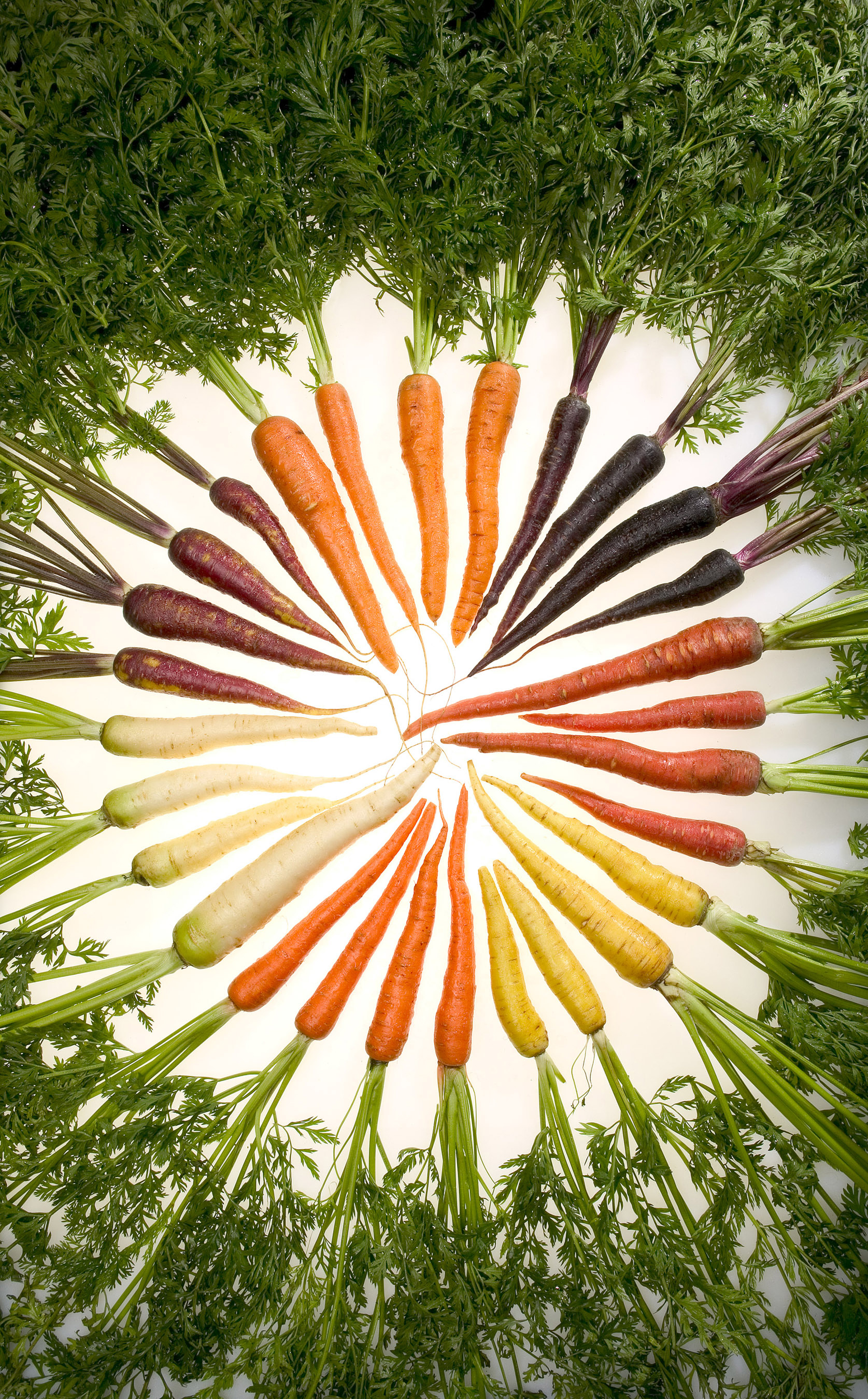
Now assuming your pantry already has some of these ingredients right?
This can be a very fun and under $10.00 Dollars ...
Depends on your pantry .. Maybe this is a great opportunity to re-do some of your pantry and bring in some natural ingredients. At the end you and your wallet will benefit!
Again if you have a lot of these ingredients in your pantry , this is a great inexpensive cake.
All Natural, Organic and Vegan.
Enjoy!
Now assuming your pantry already has some of these ingredients right?
This can be a very fun and under $10.00 Dollars ...
Depends on your pantry .. Maybe this is a great opportunity to re-do some of your pantry and bring in some natural ingredients. At the end you and your wallet will benefit!
One Layer: Using 9 x 11 rectangle Pan.
Chef Mayra's Vegan Carrot Cake
Ingredients:
Double everything "For the Cake and the icing. "
Use Icing as the filling.
***** great recipe if you want to use your carrot pulp after Juicing !! YEAH!
Chef Mayra's Vegan Carrot Cake
Ingredients:
- 1 cup non organic vegetable salad oil
- 2 cups organic brown sugar
- 1 cup water
- ½ cup soy milk
- 4 cups unbleached flour (or all purpose flour)
- 2 teaspoons aluminum free baking powder
- 2 teaspoons baking soda
- 1 teaspoon salt
- 1 ½ teaspoons cinnamon
- ½ teaspoon pumpkin pie spice*
- 3 cups grated organic raw carrots
- 1 cup chopped walnuts
- 1 cup organic raisins
Icing:
- 1 container (8oz) soy cream cheese (Available in the grocery store’s health food section)
- 4 cups organic confectioner’s (powdered) sugar
- ½ cup of soy butter (margarine), softened
- 1 teaspoon vanilla extract
Directions
- Preheat oven to 350 degrees Fahrenheit.
- Grease and flour a 9” x 11” baking pan (use oil and coat with flour).
- Combine flour, baking powder, baking soda, cinnamon, and pumpkin pie spice in medium sized bowl – set aside.
- In a large mixing bowl on low speed, mix oil and sugar, add water and soymilk. Mix well.
- Gradually add flour mixture to sugar mixture on low speed until moistened, then mix on medium speed until well blended, about 2 minutes.
- Stir in grated carrots, nuts, and raisins with wooden spoon and mix well.
- Pour the mixture into baking pan.
- Bake 1 hour.
- Tip: Bake until moist but not raw in center. Insert toothpick into cake and when it comes out clean the cake is done.
- Remove the cake from oven and let cool.
Icing:
- In a small mixing bowl, on low speed mix soy butter, powdered sugar, and vanilla until smooth.
- Spread icing on completely cooled cake.
- Sprinkle with chopped nuts.
***Here is My Round Version: You might want to double up the ingredients for the cake and icing for the round version. I stack the cake with 2 or 3 layers using 8" size cake pans.
Chef Notes:

If you do not have pumpkin pie spice available, you can make your own by mixing the following:
- ½ teaspoon ground cinnamon
- ¼ teaspoon ground ginger
- ⅛ teaspoon ground nutmeg
- ⅛ teaspoon ground allspice
Double everything "For the Cake and the icing. "
Use Icing as the filling.
***** great recipe if you want to use your carrot pulp after Juicing !! YEAH!
Again if you have a lot of these ingredients in your pantry , this is a great inexpensive cake.
All Natural, Organic and Vegan.
Enjoy!
Monday, May 4, 2009
Wake up to Breakfast!


Wake up to Breakfast!
| Simple breakfast ideas for the vegan or non vegan. It's no secret that breakfast can be the trickiest meal for vegans when away from home. There are inevitably eggs or dairy in any menu option available. This is just another reason I adore having overnight guests, so that I may delight their awakening taste buds with yummy breakfast goodness that is 100% vegan.  Let me take a moment to revisit a couple of things about "Eating Vegan." In starting the transition to a vegan diet, there are a few different strategies. Some people shift into a vegan diet slowly, starting with vegan 'analogues'— plant‐based foods whose taste resembles animal products. Others simply take out the animal products from their diet and replace them with plant foods with which they're already familiar. Still others concentrate on experimenting with entirely new vegan foods, often from international cuisines. Thankfully, there is no shortage of vegan foods to help make the transition. In fact, most of the food we eat is vegan, without us knowing it!  Replacing Eggs There are several options, depending on what they are needed for. You may want to experiment. Here are some possibilities (each quantity is equivalent to 1 egg): • 1 tbsp. gram (chick pea) or soya flour and 1 tbsp. water • 1 tbsp. arrowroot, 1 tbsp. soya flour and 2 tbsp. water • 2 tbsp. flour, 1/2 tbsp. shortening, 1/2 tsp baking powder and 2 tsp. water • 50g tofu blended with the liquid portion of the recipe • ½ of a large banana, mashed • 50 ml white sauce  A word of caution, however: approaching these replacements for meat, dairy, and egg by expecting A word of caution, however: approaching these replacements for meat, dairy, and egg by expectingthem to taste identical will be setting yourself up for disappointment. The texture and taste of animal products is impossible to duplicate completely. That said, once you learn not to expect that same taste and texture you'll find the alternatives quite delicious in their own right!  Breakfast ‐ Simple Meal Ideas • Cereal or granola with nondairy milk • Oatmeal or other hot cereal • Vegan Bagel or toast with organic jelly • Pancakes • Soy or coconut yogurt • Fruit smoothie • Vegan Crepes • Tofu Scramble • Vegan Waffles • Southwest skillets MORE Ideas! The essential daily basics, right?  • Soya, Rice, Almond, Hemp milk: long‐life soya Rice, Almond, Hemp milk lasts for months and is as good as the fresh stuff, so you can keep it in stock. Use like cows' milk in any cooking. Great on cereal.  Wake Up Smoothie! ½ cup of soymilk ½ cup of silken tofu 1/3 cup of creamy peanut butter 2 bananas, frozen 2 tbsp. of organic chocolate syrup Combine the soymilk, tofu, and peanut butter in a blender. Add the bananas, chocolate syrup, and ice cubes as desired. Blend until smooth.  The Chef's Last Thoughts I like to start my days with fruit or smoothies. Some days I'm not really into more than that. Other days, however, the "growlies" take over and I need something really satisfying. Even when I'm really hungry, I'll still start out with some fruit. It never ceases to amaze me how many people do not eat breakfast! VEGAN or NOT Vegan. From trades‐people to service providers, executives to kids, real estate agents to bankers, they do not eat the meal that breaks the fast, the meal that would make them stronger, healthier and much easier to be around. I have found that people who do not eat breakfast are extremely cranky. VEGAN or NOT Vegan Some say they have no time. Well, if you have time to get dressed, you have time to eat something. Get up earlier to exercise, meditate and eat breakfast! A benefit from eating breakfast is that it helps you maintain or even lose weight and it is better for the brain, and me, especially if I have to talk business with you. So, do yourself, your co‐workers, your mate, your kids and your friends a favor. Eat breakfast! Stay Green, Lean and Sexy…With an "Animal Free" lifestyle ---------------- Now playing on iTunes: Alberto Y Los Trios Paranoias - Breakfast via FoxyTunes | ||
| |
Sunday, April 26, 2009
Why Vegan, Living Vegan


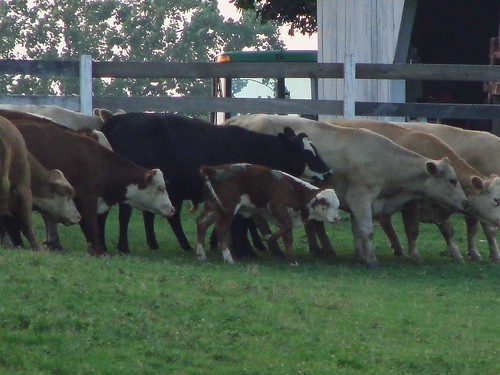


LIVING VEGAN There are many alternatives to leather, wool, and down. And many are available at local stores. For example, Payless Shoes is a dependable source for inexpensive vegan shoes. Higher quality vegan shoes, whose longevity and comfort may be closer to leather shoes, are available from Moo Shoes and Otsu, as well as Vegan Essentials , The Vegetarian Site, and Pangea (both also sell a variety of vegan products, including clothing, accessories, food, personal care items, cleaning products and more). Acrylic and 'polar fleece' are popular alternatives to wool, available at many clothing stores. Sleeping bags and coats stuffed with Thinsulate, Polyfil, and other synthetic insulation are often warmer than those stuffed with goose-down. In addition, synthetic insulation retains its properties when wet. Most outdoor stores carry many options.
Big factory pig farms are some of America's worst polluters
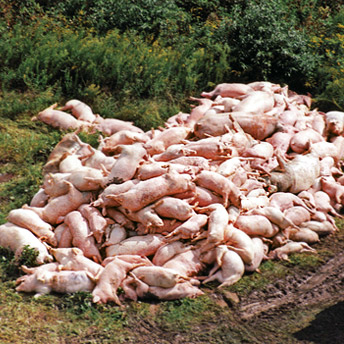
It's an investigative piece on how Smithfield Foods, America's largest hog slaughterer, circumvents law, pollutes like crazy, and creates antibiotic and vaccine-laden pork products that feed our country. I don't intend to become one of those annoying vegangelicals who tries to convert everyone to tempeh, but this was just a fascinating read:
Smithfield's holding ponds -- the company calls them lagoons -- cover as much as 120,000 square feet. The area around a single slaughterhouse can contain hundreds of lagoons, some of which run thirty feet deep. The liquid in them is not brown. The interactions between the bacteria and blood and afterbirths and stillborn piglets and urine and excrement and chemicals and drugs turn the lagoons pink.----------------Even light rains can cause lagoons to overflow; major floods have transformed entire counties into pig-shit bayous. To alleviate swelling lagoons, workers sometimes pump the shit out of them and spray the waste on surrounding fields, which results in what the industry daintily refers to as "overapplication." This can turn hundreds of acres -- thousands of football fields -- into shallow mud puddles of pig shit. Tree branches drip with pig shit.
Some pig-farm lagoons have polyethylene liners, which can be punctured by rocks in the ground, allowing shit to seep beneath the liners and spread and ferment. Gases from the fermentation can inflate the liner like a hot-air balloon and rise in an expanding, accelerating bubble, forcing thousands of tons of feces out of the lagoon in all directions.
The lagoons themselves are so viscous and venomous that if someone falls in it is foolish to try to save him. A few years ago, a truck driver in Oklahoma was transferring pig shit to a lagoon when he and his truck went over the side. It took almost three weeks to recover his body. In 1992, when a worker making repairs to a lagoon in Minnesota began to choke to death on the fumes, another worker dived in after him, and they died the same death. In another instance, a worker who was repairing a lagoon in Michigan was overcome by the fumes and fell in. His fifteen-year-old nephew dived in to save him but was overcome, the worker's cousin went in to save the teenager but was overcome, the worker's older brother dived in to save them but was overcome, and then the worker's father dived in. They all died in pig shit.
Now playing on iTunes: Prince - Peace


Friday, April 24, 2009
Cooking, Growing and Health Benefits of Cilantro . Post Includes some great Food prep Ideas from Chef Mayra


Health Benefits of Cilantro
Cilantro is known to be rich in phytonutrients, flavonoids and active phenolic acid compounds, all of which are good for you. There are no definitive studies on cilantro but many believe that it and the seeds (often called coriander), have been found to help control blood sugar, lower cholesterol and fight inflammation and free radicals. There is further speculations that cilantro may also have antimicrobial properties.
There is also considerable literature speculating that cilantro may be an effective chellation therapy for people who have excess mercury in their systems. Some think that mercury poisoning could be the result of metallic teeth fillings. Every time a person with fillings chews, the fillings release minute amounts of mercury gas that may be breathed into the system (swallowing mercury is actually far less toxic than breathing it). Of course, this is all speculative and disputed. Nevertheless, many people who have suffered from mercury poisoning and the "brain cloud" it causes have reported fairly rapid relief by the consistent consumption of cilantro over a period of just a few weeks.
Cilantro is also reported to deal effectively with other metals in the system. Consumption of about two teaspoons of cilantro pesto daily for three or four weeks may have beneficial effects.
Cooking with Cilantro
Cilantro is found in many dishes, but it is most common in Asian and Mexican preparations. When purchasing cilantro, most people get the leafy herb fresh from the vegetable section of the grocery store. Be careful when purchasing as cilantro will wilt and spoil quickly. Get it as fresh as possible, you can store it in an air filled bag in the crisper of your refrigerator. If you have some left over after a recipe, you might consider dehydrating the leaves for use in soups and baked dishes.
The seeds are also called for in many recipes. The seeds can be found dried in the spice section under the name "coriander". The flavor of the leaves as opposed to the seeds is vastly different. The popular herb has an unusual flavor that leaves a pleasant if unusual aftertaste in the upper palate. While the seeds have a more lemony flavor and a somewhat different texture.
In cookbooks, you will often find cilantro referred to as Chinese Parsley, especially if the recipe happens to be in an Asian style.(It is also labeled this way in some grocery stores.) You may also see it referred to as Mexican Parsley. In Asian cooking, it may be found in salads, dressings, soups, and as a strong addition to Thai dishes. The coriander seeds are not often used in Chinese dishes, but are a frequent ingredient in Indian and Thai dishes.

Chef Mayra' Cream of Cilantro Soup
If your guests do not mind a vaguely green soup, you may find cream of cilantro soup the hit of your dinner party.
Ingredients: Organic if Possible
1 1/2 cups fresh cilantro (stems removed)
3 cups veggie broth
4 tablespoons vegan butter
4 tablespoons unbleached flour
1 eight ounce container of vegan sour cream
4 cloves garlic (minced)
dash sea salt
1/4 teaspoon red pepper
1/4 teaspoon cumin
Directions:
Place cilantro leaves in blender, pour in the veggie broth. Puree until smooth. Set aside.
In wide sauce pan over medium heat, melt vegan butter. Add flour and mix thoroughly until all the flour is coated in vegan butter. Add the blended mixture and stir constantly until soup thickens. Add in garlic and spices. About 2 minutes before serving add sour cream and heat until soup is sufficiently hot to be served. If you overcook the vegan sour cream, letting it heat and cool, it can curdle. Serve in bowls. May garnish with a cilantro leaf or two.
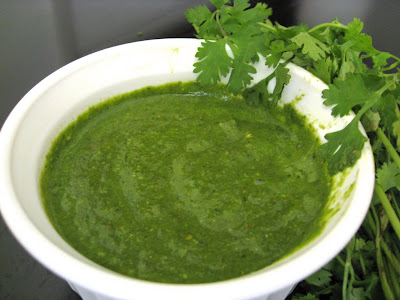
Chef Mayra's Cilantro Chutney
This is one of those authentic recipes that you must try if you are cilantro lover.
Ingredients:
2 cups is cilantro
2 cloves garlic
1 teaspoon ginger
1/2 cup of mint leaves
1 hot pepper
2 large tomatoes
1 onion - chopped
Directions:
"put everything in the food possessor and puree it. Salt to taste. Eat with bread or rice."
This also will go well a dollop at a time on crackers.

Simple Cilantro Salsa ( Pico de Gallo)
Chef Mayra's Cilantro Salsa is a great way to spice up a party. Perfect for chip dipping, an addition to tostadas, buritos, Spanish rice or bean dip.
Ingredients:
1/2 cup chopped fresh cilantro
6 Roma tomatoes
1 white onion, diced tiny-like
1 diced jalepeno pepper
juice of one lemon
juice of one lime
salt to taste
Directions:
Make sure everything is thoroughly diced or chopped. Put in a bowl or a quart jar. Refrigerate over night to allow a good blending of flavors.
----------------
Now playing on iTunes: Abraham-Hicks - Is this a vibrational match?
via FoxyTunesv>
How to Grow Cilantro
Cilantro or coriander will grow in a great variety of locations and conditions. However, it does best in sunny locations on rich, well-composted patches that are well drained. An excess of nitrogen will delay the ripening of the coriander seed, but is actually better for those who grow the plant strictly for the cilantro leaves. Nevertheless, try to harvest the leaves earlier rather than later as older leaves tend to have a stronger flavor.
For best results it is best to have relatively even temperatures over a 90 to 100 day period. Heavy rain or wind will take a toll on both the cilantro leaves and the coriander seeds. Plant the seed as soon as the soil is warm enough for germination and there is no danger of frost killing the young plant. Seeds should be planted thinly at a depth of about one inch. The rows should be at least 15 inches apart to avoid crowding.
Weed fairly frequently. Cilantro grows one to three feet high, but it can be overpowered by unwanted plants. Broadcasting seeds to form a cover crop is not recommended for the same reason. Native weeds will tend to dominate. If possible, plant in early May in temperate regions. Some leaves may be harvested in just a few weeks, but the plant will not bloom until July and the coriander seeds will not mature until early August.
The coriander seeds may be harvested when they turn light brown. The small fruit will be about 1/8 inch in diameter. To preserve them, they should be dried and split in half. This is an annual plant, but leaving the seeds go, the gardener may expect a considerable number of volunteers the next year.

Chef Mayra Organic Mixed Green Salad With Cilantro-Lime Vinaigrette
Prep: 15 min. Add extra jicama to coleslaw for a crunchier texture, or serve it with other fresh vegetables for dipping in your favorite dressing.
Makes 4 servings
Ingredients
* 1 (5-oz.) mixed salad greens, thoroughly washed ( veggie wash)
* 2 oranges, peeled and sectioned
* 1 avocado, sliced
* 1/4 cup peeled, cubed jicama (about 1/2-inch cubes)
* 6 tablespoons Cilantro-Lime Vinaigrette (below)
Preparation
1. Toss together first 4 ingredients in a large bowl. Serve immediately with Cilantro-Lime Vinaigrette.

Chef Mayra's Cilantro-Lime Vinaigrette
Prep: 10 min. Use extra vinaigrette on salads or as a marinade.
This recipe goes with My Mixed Green Salad With Cilantro-Lime Vinaigrette
Makes 3/4 cup (serving size: 1 1/2 tbsp.)
Ingredients Organic if Possible
* 1/2 cup apple cider vinegar
* 2 tablespoons chopped fresh cilantro
* 1 teaspoon grated lime rind
* 2 tablespoons lime juice
* 1 tablespoon agave nectar (dark)
* 1/4 teaspoon salt
* 1/4 cup olive oil
Preparation
1. Whisk together first 6 ingredients; add oil in a slow, steady stream, whisking constantly until smooth. Whisk well before serving.
----------------
Now playing on iTunes: Abraham-Hicks - Abraham-HIcks Publications
via FoxyTunes
Monday, April 13, 2009
Cooking With Lemon Balm 4-13-2009 Show


Lemon Balm: Herb of the Year 2007
Light and fresh, lemon balm adds a splash of citrus and mint undertones to both savory and sweet dishes. Use the young tops of the plant for cooking and teas because the large, older leaves tend to have a soapy, musty flavor. It is best used fresh but can be dried quickly and stored carefully for use in teas and herb blends; on drying it will lose some of the nuance of its flavor.
Gather and use generous amounts of fresh lemon balm leaves and add after cooking whenever possible to maintain the delicate aroma. Cooking lemon balm too long will dissipate its flavor.
Light and fresh, lemon balm adds a splash of citrus and mint undertones to both savory and sweet dishes. Use the young tops of the plant for cooking and teas because the large, older leaves tend to have a soapy, musty flavor. It is best used fresh but can be dried quickly and stored carefully for use in teas and herb blends; on drying it will lose some of the nuance of its flavor.
Gather and use generous amounts of fresh lemon balm leaves and add after cooking whenever possible to maintain the delicate aroma. Cooking lemon balm too long will dissipate its flavor.
| Herb Blend | Uses |
| 3 parts lemon balm, 1 part borage flowers, 1 part spearmint | Fruit beverages; steeping in wines; simple syrup for drinks and fruit salads; a stimulating tea |
| 3 parts sorrel, 1 part lemon balm | Fresh salads; add to other greens or raw ve getables; salad dressings |
| Equal parts lemon balm, sweet cicely, lemon-scented geranium leaves | NON DAIRY puddings, custards, ice cream, fruit cocktails |
| 2 parts sorrel, 1 part lemon balm, ½ part thyme | TEMPEH and Tofu: use as a rub before grilling, frying or baking |
| Equal parts lemon balm, sweet cicely, lemon verbena | Great for pasta; flavor rice and grains such as couscous; a light lemon tea |
| 2 parts lemon balm, 1 part orange peel, ½ part rosemary | Flavor wines; with Agave a throat-soothing tea |
| 2 parts lemon balm, 1 part each marjoram and thyme | Tomato sauces; add to poaching liquid for to create a Nice flavor* lemony sauce |
| Equal parts lemon balm, chervil and sweet cicely | Fruit pies, Non Dairy puddings, custards, fruit salads |
| 2 parts sage, 1 part lemon balm, ½ part each thyme | Gr eat seasoning and marjoram or oregano |
| 2 parts lemon balm, 1part each hyssop and mint | Stimulating tea; herbed simple syrup |
| 2 parts lemon balm, 1 part catnip, ½ part German chamomile | Sleep-inducing tea |
| 1 part lemon balm, ½ part sweet cicely, ¼ part lavender flowers | Rel axing, soothing tea; flavor desserts, baked goods; herbed simple syrup |

Lemon balm may not be much to look at but the delightful fragrance is irresistible to children, bees , Chefs and gardeners. Don't be confused by its many names. Try it in your tea or sniff it to lift your spirits, you can call it whatever you like.
Some herbs are more straightforward than others. Basil is basil, every herb lover knows it. Rosemary is rosemary, there is
no other name for it. Lemon balm is another matter.
Lemon balm is also known as sweet melissa or sweet balm or just plain balm. But it is not to be confused with bee balm, even though bees love it. Lemon balm is often mistaken for lemon verbena although they look nothing alike. It does look like mint because it is in that family.
Sweet melissa is easy to explain as a natural extension of the Latin name Melissa officinalis although bee balm would make e sense, too, since the Greek translation of melissa is bees. The variations on balm may point to the herb's calming applications. Sweet balm has been used throughout the ages as a salve for burns and bites as well as for lifting spirits or as a sedative.The lemon part of the moniker is obvious with the first sniff of the leaves. A strong lemon scent wafts from the plant with a mere brush against it. The lemon taste is as strong as the aroma.
Lemon balm is a modest herb in appearance . With smallish oval leaves and discreet white flowers, it will grow two or three feet high. As a member of the Lamiaceae (formerly Labiatae), or mint, family, this perennial will self-seed into rambunctious growth and may offer three harvests per season if it is cut back after each blooming.

Recipes
Lemon-Berry Chardonnay Cordial
Makes 3 cups
Lemon balm was traditionally consumed in wine cups and cordials for its medicinal benefits. Vegan Chablis or any other white wine may be substituted for the Vegan Chardonnay, or use this sweet, thick syrup as a sauce for puddings, custards and other desserts.
¾ cup Raw sugar
¼ cup chopped fresh lemon balm
3 cups Organic fresh or frozen blueberries, raspberries, strawberries or blackberries
3 cups Vegan Chardonnay
In a blender or food processor, process sugar and lemon balm until leaves are finely chopped and mixed with the sugar. Wash and drain berries and place in a quart jar.Sprinkle herbed sugar over berries. Add wine to jar and cover. Refrigerate for at least 1 month, or until mixture is slightly thick and sweet.
For an aperitif: Strain and pour into glasses. Garnish with lemon balm sprigs.For a cool summer beverage: Strain and pour ¼ cup into a tall, ice-filled glass. Fill the glass with soda water or sparkling water. Garnish with lemon balm sprigs.
For a dessert sauce: Spoon over fresh fruit or Coconut or Soy ice cream.
Peach, Avocado and Arugula Salad with Lemon Dressing
Serves 4
Peppery arugula leaves are softened by the bright, slightly sweet and aromatic combination of lemon balm and basil.
Bread:
4 slices Wheat French bread, cut on the diagonal
2 tablespoons Organic olive oil
1 clove Organic garlic cut in half
Organic Salad:
2 cups fresh arugula leaves
½ cup fresh lemon balm leaves
¼ cup red onion slices
Fresh basil leaves, finely shredded
1 ripe avocado, sliced
2 ripe peaches, peeled and sliced
4 whole fresh lemon balm sprigs, optional
Organic Dressing:
5 tablespoons extra-virgin olive oil
1 tablespoon rice vinegar
1 tablespoon fresh lemon juice
2 tablespoon chopped fresh lemon balm
Salt and freshly ground pepper
Preheat broiler. Arrange bread on a baking sheet and drizzle with olive oil. Broil for 2 to 3 minutes, turn and broil for another 2 minutes, or until bread is golden brown. Remove from oven and rub both sides with garlic; set aside.
To make salad, toss arugula, lemon balm, onion and basil in a bowl; set aside.
To make dressing, combine oil, vinegar, lemon juice and lemon balm in a jar with a tight-fitting lid. Cover and shake well. Add salt and pepper to taste. Add half the dressing to arugula and herbs; toss lightly.
To serve, place one bread slice on a plate. Spoon ¼ of the salad over bread. Arrange avocado and peach slices over salad. Drizzle remaining dressing over fruit. Garnish each with a sprig of lemon balm, if desired, and serve immediately.
Corn Fritters with Lemon Pesto
Serves 4
Serve these lightly fried fritters as a vegetable accompaniment or main dish.
Use regular or sweet potatoes.
Buy Organic
1 cup fresh or frozen corn kernels
1 cup shredded carrot or parsnip
1 cup shredded potato
2 green onions, finely chopped
2 tablespoons chopped fresh lemon balm
3 tablespoons shredded VEGAN mozzarella cheese
2 tablespoons unbleached all purpose flour
Equivalent to 1 egg replacement ( use also ready Made tempura batter)
SEA Salt and freshly ground pepper
3 tablespoons olive oil or Any pressed Oil such as; Apricot Kernel, Grape Seed or Coconut Oil.
In a large bowl, combine corn, carrot, potato, onions, lemon balm and Vegan mozzarella cheese. Stir to mix well. Add flour and egg replacement ( fallow the package instructions) and mix to combine. Add salt and pepper to taste. Mixture should be just moist enough to hold together. If not, add more flour until mixture is the desired consistency for forming into patties.
Lemon Lovers Tea
Ingredients: 1/4 cup dried lemon balm leaves 2 tablespoons dried lemon thyme leaves 1/4 cup dried lemon verbena leaves 1/4 cup dried lemon geranium leaves 2 tablespoons dried lemon grass leaves 1 tablespoon dried lavender blossomsMix all together and use a tsp. or so per cup of boiling water. If you are missing any of the lemon herbs, just use more of the ones you do have.
Lemon Mint Sun Tea
Ingredients: 1/2 cup mint 1/2 cup lemon balm 1/2 cup chamomile flowers 3 black tea bagsPlace in a gallon container and add cold water to fill the jar. Set in the sun for several hours. Strain our tea and herbs. Pour over ice and refrigerate the leftovers. Sweeten with honey or sugar if desired.
Rose and Herb Tea
Ingredients: 1/2 cup dried red rose petals (make sure no sprays were used) 2 tablespoons dried lemon balm 1 tablespoon dried rosemaryMix well. Use 1 teaspoon for each cup and pour boiling water over the herbs, then strain after 5 minutes or so. Sweeten as desired.
Lemon Balm Vinaigrette
Ingredients: 3 tablespoons light olive oil 1/8 teaspoon salt 6-8 leaves lemon balm Fresh black pepper to taste 2 tablespoons wine vinegar Stack the lemon balm leaves together and roll, then with a very sharp knife cut thin strips, and then chop finely. Combine with the other ingredients and serve with steamed vegetables or mixed salad greens.
Lemon Orange Vegan Cheese Spread
Ingredients: 2 ounces Vegan butter, softened 8 ounces Toffuti ( Non Dairy) cream cheese, softened 2 Tbsp. Organic orange marmalade 1 tsp. orange zest 1 Tbsp. fresh fresh orange juice 3 Tbsp. chopped fresh lemon balmBlend the Vegan butter and Non Dairy cream cheese until smooth. Mix in the other ingredients. Chill overnight and serve at room temperature.
Lemon Astringent
Ingredients: 1 Tbsp. fresh lemon balm 1 cup witch hazelCombine the ingredients in a jar with a tight-fitting lid. Allow to steep for 1 week. Strain. Use 1 teaspoon per application with a cotton ball. Refrigerate if you wish.
Lemon Herb Vegan Butter
Ingredients:2 tablespoons lemon balm, chopped fine
2 tablespoons thyme, chopped fine
1 cup Vegan butter, softened
Cream butter and stir in herbs. Chill for at least 3 hours to allow flavors to blend. Use with baked potatoes or vegetables.
( Or anything else you can think of )
Snow Peas with Almonds and Lemon Balm
Makes 2 side dish servings.
2 Tablespoons sliced almonds
4 ounces fresh snow peas
1 Tablespoon chopped fresh lemon balm leaves
1/8 teaspoon cracked black pepper
1/8 teaspoon Kosher or Sea salt
1 Tablespoon olive oil
Toast the almonds by placing them in a small dry skillet over medium-high heat. Shake or stir, watching carefully, until they are golden brown. Remove from heat; transfer to a small bowl.
String the snow peas, if desired, and slice crosswise into 1/2-inch lengths. After the almonds have cooled, mix in the lemon balm, black pepper and salt, crushing the nuts slightly as you mix.
Heat the olive oil in the same small skillet over medium-high heat. Add the snow pea pieces; stir fry for 4-5 minutes. Reserve 1 Tablespoon of the almond-balm mixture and stir the rest of it into the snow peas. Transfer to a serving dish and sprinkle with the reserved mixture.
********************************
Lemon balm is an easy to care for herb that grows similar to mint. It likes some shade during the hot part of the day or it will wilt slightly. I find it very drought tolerant and rarely give it extra water unless we go quite awhile without rain. In fact, it doesn't like wet feet, and prefers a loose, fairly fertile soil. It will tolerate dry soil as well. I harvest my plant at least 3 times each summer and still have more than I can use with just one plant. It can be harvested within 2-3 inches from the base of the plant each time and it comes back with vigor! I've read that in some parts of the United States it's becoming known as a pest, but I've found that if you keep it harvested and don't allow it to go to seed it stays under control.
You can divide lemon balm in the spring or fall. You can also take cuttings in midsummer to bring in for the winter. It can be grown from seed in the spring, or started indoors in late winter and transplanted.
Lemon balm is not considered an ornamental herb, but I think the leaves are pretty, and I can't resist grabbing one each time I pass it to smell the lovely lemon scent. I have mine located next to my sage plant, which is great for snipping both herbs quickly before cooking.
To harvest, cut the whole stems within a few inches of the base of the plant, gather into groups of 5-6 stems, tie and hang in a warm, airy location. When dry, strip off the leaves, store in a covered container and use as needed.
A handful of fresh lemon balm and mint make an excellent hot or iced tea when agave is added. It can be used in place of lemon peel in recipes. Add it to your favorite vegan sugar cookie dough for a pretty vegan tea cookie.
I think of it as much more than a tea herb! I add it to herbal vinegars along with dill and nasturtiums for a pleasant variety of vinegar that can be used in marinades or salad dressings.
Subscribe to:
Posts (Atom)

Vegan Cakes By Dr Flavor

Call The bakery Order ONE NOW 100% Vegan 702 722-0108
** LOOK ma" No Eggs!

Vegan Dessets OO SEXY !!
ooo BABE ~ IS GOOD
THIS COULD BE FUN


 Posts
Posts